- Updated:
- Published:
How Latin American iGaming players differ by country

Blask Customer Profile data shows why operators should stop treating Latin America as one audience and plan around local player motivations.
Latin America is easy to group into one iGaming story. Football matters across the region. Social media plays a major role in brand discovery. Earning money appears often as a betting and casino motivation.
Those similarities are real. They are also too broad to guide acquisition.
Blask Customer Profile data shows five different player jobs across Argentina, Mexico, Chile, Ecuador, and Venezuela. Each market combines product preference, motivation, age, and discovery channel in a different way.
That combination matters because operators do not acquire “Latin American players” in the abstract. They acquire Argentine sports bettors, Mexican live casino users, Chilean employed players, Ecuadorian adrenaline seekers, and Venezuelan entertainment-first players.
What Blask Customer Profile measures
Blask Customer Profile models the typical iGaming player in a market. It covers demographics, income, education, employment, product use, betting motivations, casino motivations, device behavior, discovery channels, and problem gambling indicators.
For operators, the value is simple. Market size tells you where demand exists. Customer Profile helps explain who creates that demand and what message is likely to move them.
This article uses updated Customer Profile data for five Latin American markets, all updated on April 23, 2026: Argentina, Mexico, Chile, Ecuador, and Venezuela.
📖 Read more: What is Blask Customer Profile and how it revolutionizes iGaming analytics
Latin American iGaming players are regional, but not interchangeable
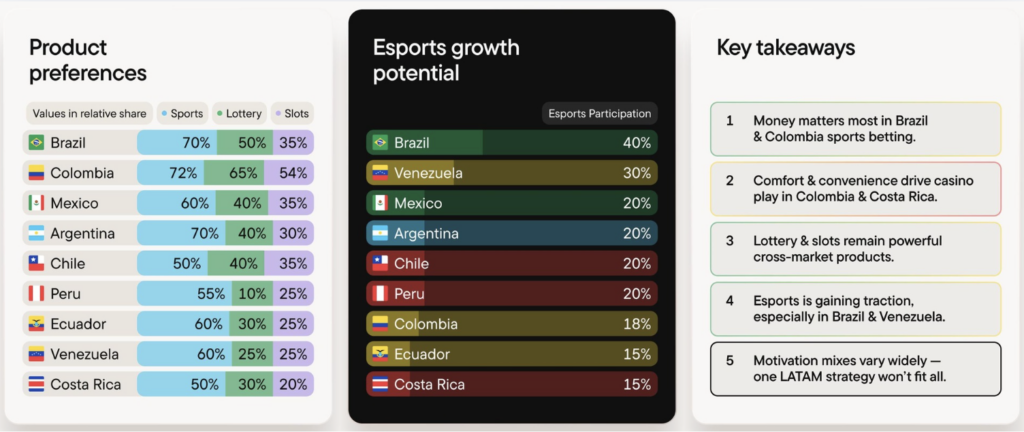
At the top level, the region has a clear sports bias. Traditional sports betting leads product use in all five markets in this sample. Social media also ranks as the top brand discovery channel across the region.
That does not mean one creative strategy will travel cleanly from Buenos Aires to Mexico City, Santiago, Quito, and Caracas.
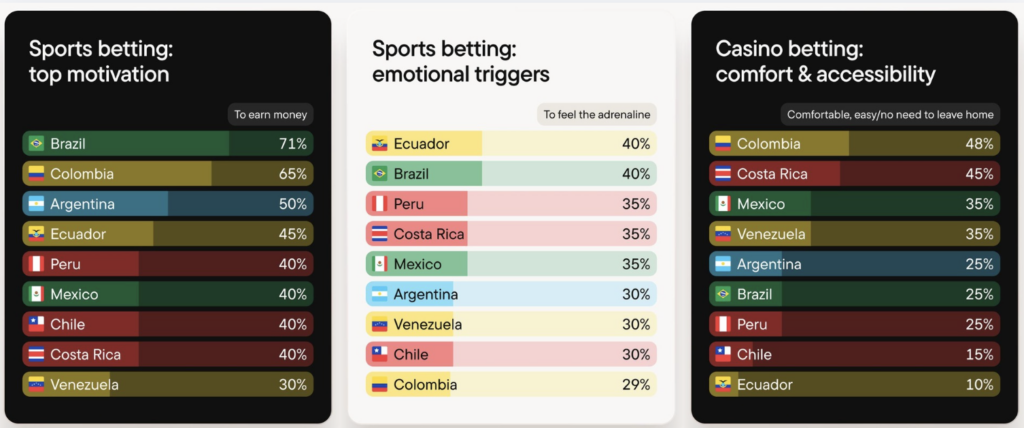
The data changes once you combine product and motivation. Argentina pairs the strongest traditional sports usage with a clear casino-for-money signal. Mexico has the youngest core audience and a high live casino share. Chile looks more balanced across sports, live casino, and lottery. Ecuador keeps money and adrenaline close together. Venezuela leans more toward entertainment and convenience than a pure money-led message.
Regional averages hide those differences. Acquisition teams should not.
Argentina: football reach, casino intent, social discovery
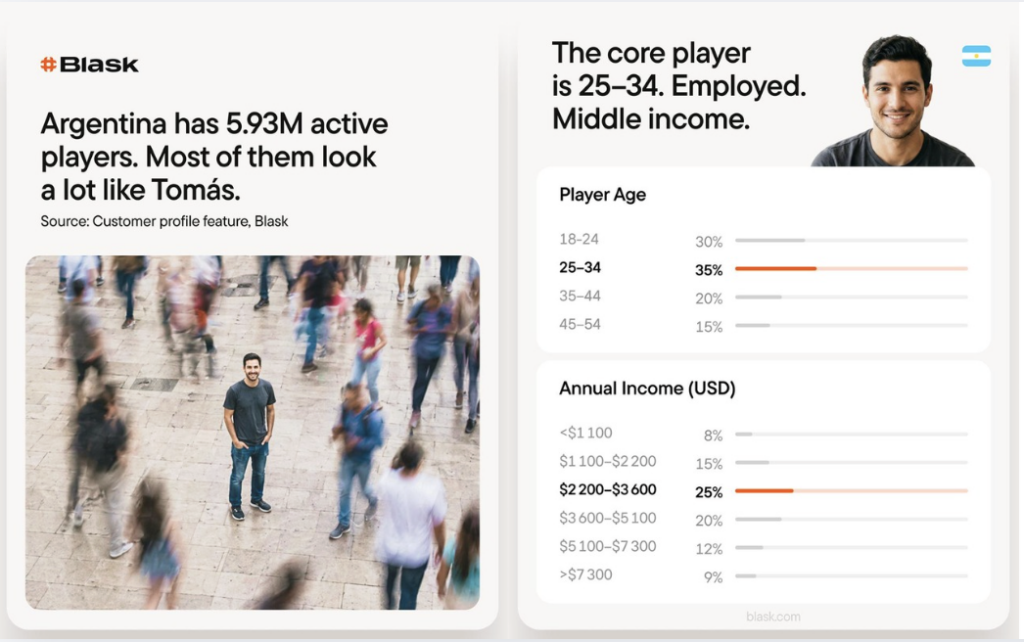
Argentina has a 25–34 core player group, at 35% of the profile. Traditional sports betting leads product use at 70%, the highest figure across the five countries. Lottery follows at 40%, while live casino reaches 35%.
The first conclusion is obvious: sports gives operators reach in Argentina. The second one is more useful: casino carries direct monetary intent.
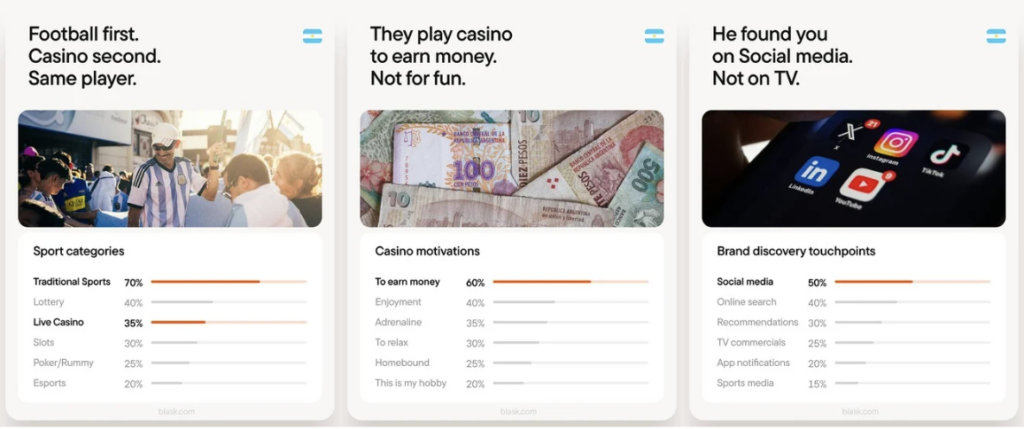
In the Customer Profile data, 50% of Argentine players bet on sports to earn money. For casino, that share rises to 60%. That means the sportsbook can open the relationship, but casino messaging can speak more directly to the financial reason players give for engaging.
Brand discovery also has a clear lead channel. Social media reaches 50%, ahead of online search at 40%. In practical terms, Argentina rewards operators that can connect football-led attention, casino-led intent, and social-first acquisition.
Argentina’s regulatory structure also pushes operators to think locally. Gambling regulation is handled at the provincial level, with the City of Buenos Aires regulated by LOTBA. That makes country-level strategy useful, but jurisdiction-level execution still matters.
Mexico: younger players and a stronger live casino signal
Mexico stands out by age. The largest player group is 18–24, at 30%. That does not make Mexico a youth-only market, but it changes the acquisition frame.
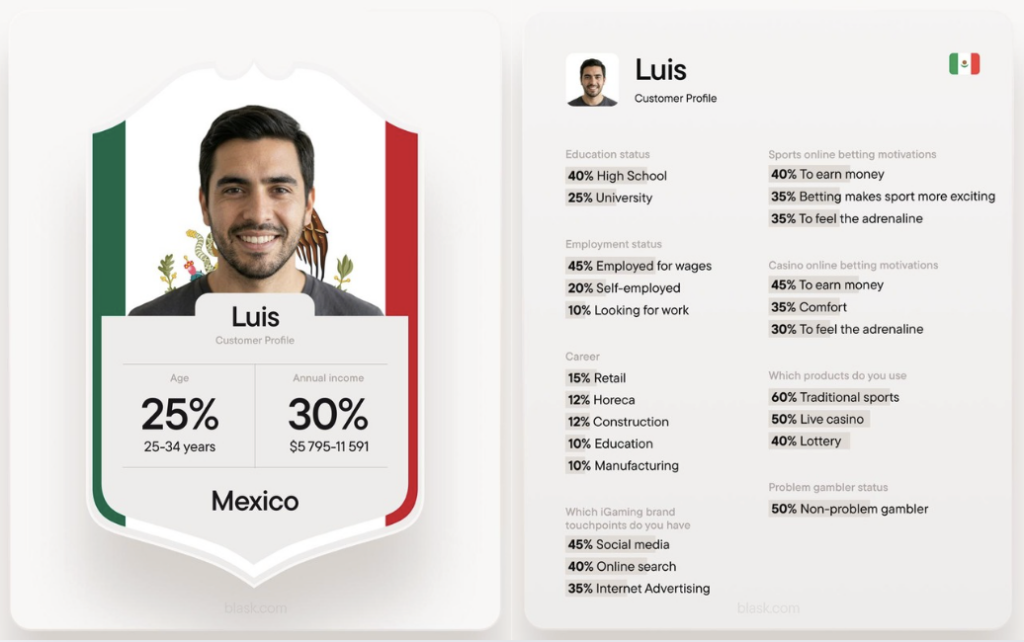
Traditional sports betting still leads at 60%. Live casino reaches 50%, which makes Mexico less sports-only than a regional stereotype would suggest. Operators that treat Mexico only as a sportsbook market risk missing a large mixed-product audience.
Motivation is also direct. In sports betting, 40% of players cite earning money. For casino, that rises to 45%. The difference between the two products is not as sharp as in Argentina, but the product mix is broader.
The channel story remains social-first. Social media accounts for 45% of brand discovery. For younger Mexican players, that makes creative sequencing important: mobile-first content, fast product proof, and a short path from discovery to play.
Mexico’s national framework sits under the Dirección General de Juegos y Sorteos, part of SEGOB. For operators, that creates a different planning environment from Argentina’s province-by-province model.
Chile: a salaried core with a balanced product mix
Chile has the cleanest salaried-player profile in this group. The 25–34 age band leads at 35%, and 50% of the profile is employed for wages.
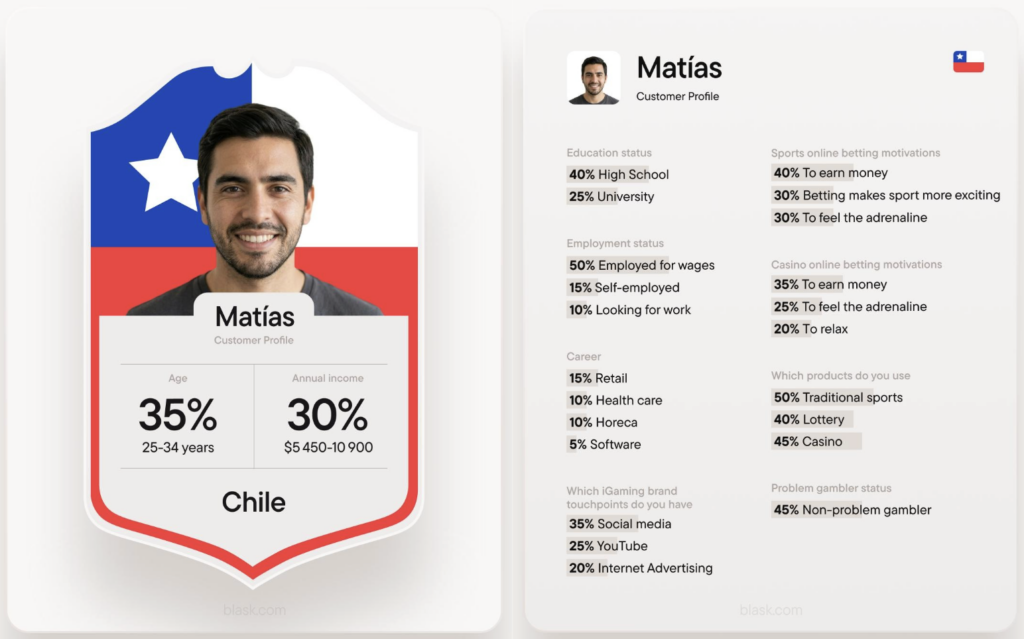
Product use is also more balanced. Traditional sports betting leads at 50%, but live casino reaches 45% and lottery reaches 40%. That narrows the gap between sports and casino compared with Argentina or Ecuador.
This matters for positioning. Chilean acquisition should not rely only on football-led hooks. Sports still leads, but the player profile supports a broader wallet strategy across live casino and lottery-style products.
Motivation follows the same pattern. Sports betting is money-led at 40%. Casino is also money-led, but at 35%, which leaves more room for entertainment and product experience to shape the offer.
Chile also has an active regulatory debate around online betting. A June 2025 Ministry of Finance presentation described a bill to regulate online betting platforms and noted that the market had grown at an estimated 10% annually over the previous five years, while the country still lacked effective tools against illegal online gambling. The same presentation tied regulation to responsible gambling, consumer protection, and fiscal oversight.
For operators, the lesson is simple. Chile looks like a market where product breadth and trust cues should sit next to acquisition creative.
Ecuador: money and adrenaline stay close together
Ecuador is more direct. The core age group is 25–34, at 35%. Traditional sports betting leads at 60%, while the top sports betting motivation is earning money, at 45%.
But the second motivation matters. Adrenaline reaches 40%, close enough to shape the message. Ecuador is not only a “win money” market. It is a sports-led market where the emotional charge of betting remains close to the financial promise.
Casino motivation points back to money. Half of casino players cite earning money as the main reason to play. That is the highest casino money signal in the five-country set after Argentina.
Brand discovery is social-first, at 45%. The acquisition angle should combine direct value, sports intensity, and social proof. A generic regional campaign would flatten that mix.
For teams planning Ecuador, the key is not the product category alone. The key is the emotional job attached to the product. Sports gives reach. Money gives the rational hook. Adrenaline gives the creative energy.
Venezuela: entertainment and convenience lead more clearly
Venezuela changes the ending of the old regional story. The profile is still sports-led, with traditional sports betting at 60%. The core age group is 25–34, at 33%. Social media is the top discovery channel, at 50%.
The motivation data is where Venezuela separates from the rest.
For sports betting, the leading motivations are passing time and playing from any convenient place, both at 40%. For casino, passing time leads at 45%, while playing from a convenient place reaches 40%.
That makes Venezuela the clearest entertainment and convenience market in this sample. Money still matters, but it does not lead the way it does in Argentina, Ecuador, or Mexico.
This changes the acquisition message. A pure “earn money” campaign would miss the strongest stated use case. Venezuela needs a lighter product story: easy access, entertainment, and play that fits into spare time.
All in one:
What operators should do with this data
The main risk in Latin America is not misunderstanding the region. It is understanding it too broadly.
Customer Profile data points to five practical moves:
- Treat Argentina as sports-led for reach, but casino-led for monetary intent
- Treat Mexico as a younger mixed-product market, not only a sportsbook market
- Treat Chile as a balanced market where trust, employment, and product range matter
- Treat Ecuador as a sports-led market where money and adrenaline should both shape creative
- Treat Venezuela as an entertainment and convenience market before a pure money-led market
The same product can carry different meanings by country. A live casino offer in Mexico may support product variety. In Chile, it may sit inside a broader wallet strategy. In Venezuela, it may need to feel easy and entertaining before it feels financially motivated.
That is where Customer Profile becomes useful. It does not replace local expertise, media testing, or compliance work. It gives teams a sharper starting point before they spend budget.
Conclusion: local motivation beats regional averages
Latin America remains one of the most important regional growth stories in iGaming. But operators do not win the region by speaking to a regional average.
They win market by market.
Blask Customer Profile shows where the differences start: age, product choice, motivation, and discovery channel. The most efficient acquisition strategy matches the offer to the local player job, not to the continent-level stereotype.