- Updated:
- Published:
How to choose an iGaming market

Market entry works when demand, competition, regulation, product fit, and timing point in the same direction.
Choosing a new iGaming market used to start with a simple question: where is the biggest opportunity?
That question is too broad now. The global online gambling market keeps growing, with Research and Markets estimating $143.17B in 2026 revenue and $212.44B by 2030. But market size alone does not tell an operator where to launch, an affiliate program where to recruit partners, or an affiliate where to send traffic.
The better question is sharper: which market can you win, with the product, traffic, compliance setup, and local knowledge you already have?
This is where market selection becomes a data problem. You need to compare demand growth, brand concentration, category interest, regulatory pressure, player behavior, and content fit before you commit budget.
Start with demand, then test the quality of that demand
A growing market can still be a bad entry point.
Blask Index helps separate real demand from surface-level momentum. It is an AI-enhanced demand signal built from search activity across iGaming brands. It shows how much attention brands generate in a country before that interest turns into deposits, bets, or revenue.
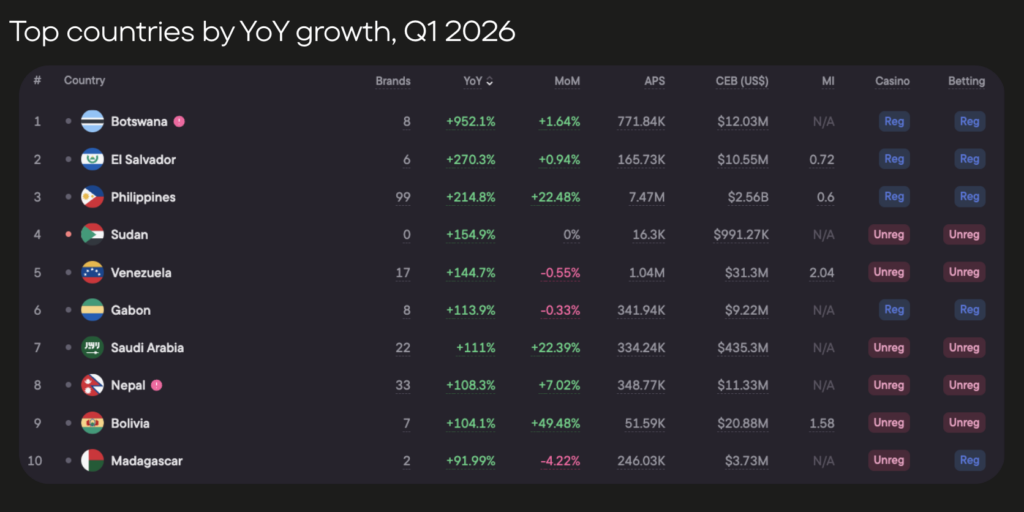
For market entry, the first read is simple:
- Is the market growing, falling, or flat?
- Is the growth steady, or driven by one seasonal spike?
- Is demand moving toward brands, categories, games, or events you can actually serve?
This distinction matters because a short-term spike can hide a weak base. A sports event, payment change, bonus campaign, or enforcement action can move the market for a few weeks. That does not automatically create a durable entry opportunity.
The stronger signal is repeated demand. If player interest rises across multiple periods, several brands grow at the same time, and category demand supports your product, the market deserves a closer look.
Blask tip: Do not stop at year-over-year growth. Compare several time windows, then use Market Explanation to understand what caused the movement.
Measure how hard the market is to enter
The next question is not “how big is the market?” It is “who already controls the market?”
Brand Accumulated Power (BAP) measures a brand’s share of total market demand in a country and period. It is useful because it shows concentration. A market with strong demand but two dominant incumbents behaves differently from a market where dozens of mid-sized brands compete for share.
Nigeria is a useful example. In Blask data for April 27, 2025 to April 26, 2026, Nigeria had 173 active brands and an average Competitive Earning Baseline (CEB) of $659.55M ($492.07M–$1.16B range). But the market is concentrated. SportyBet and Bet9ja together accounted for roughly 73% of tracked Blask Index demand in the period.
That does not mean Nigeria is unattractive. It means entry strategy has to reflect incumbent strength. A new operator needs a clear wedge: product, pricing, local brand trust, payments, media, or affiliate access.
Brazil tells a different story. Over the same period, Blask tracked 516 active brands in Brazil and an average CEB of $5.88B ($4.08B–$11.27B range). Betano led the market with 19.3% year-over-year growth, while Superbet grew 71.87%. That mix of scale, active competition, and shifting brand positions creates more paths to entry, but also raises the cost of standing out.
CEB is Blask’s market-based revenue benchmark. It estimates how much revenue a brand or market position can support based on demand, brand strength, and competitive context. Blask reports CEB as a range because outcomes depend on competition, seasonality, and campaign timing.
Compare acquisition power before you compare revenue
Revenue potential matters, but acquisition pressure often decides whether a market is workable.
Acquisition Power Score (APS) estimates how many new customers a brand’s market position should be able to attract. Like CEB, APS is a min-average-max range because acquisition changes with seasonality, media intensity, events, and competitor campaigns.
- For operators, APS helps answer a practical launch question: if we reach this level of market visibility, how many new customers should we expect?
- For affiliate teams, APS helps identify brands that are actively acquiring. A mid-sized brand with rising APS can be more commercially useful than a large incumbent that is flat. It signals budget, appetite, and urgency.
- For affiliates, APS helps filter partner lists. If a brand is growing, has credible market presence, and operates across several geographies, it is more likely to be a reliable partner than a small operator with one unexplained spike.
This is one of the most useful ways to turn Blask data into action: look for brands that are not just big, but actively moving.
Check category fit before committing traffic
Market demand and product fit are not the same thing.
A country can be attractive for sports betting and weak for casino. Another can have strong slots demand but limited live dealer interest. If your traffic, CRM, or platform is built around the wrong category, the market can look good on paper and still underperform.
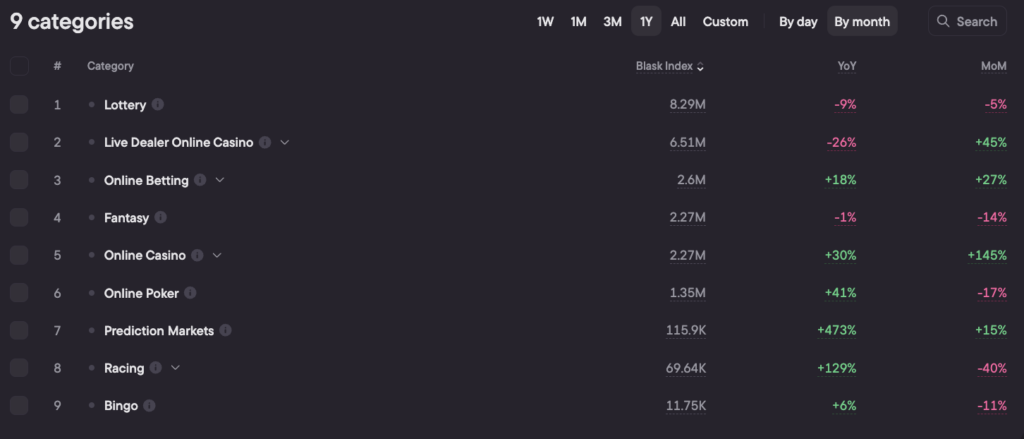
Blask category data helps answer three questions:
- Which categories drive player interest in the market?
- Are those categories growing or losing demand?
- Does your current product or traffic match the demand mix?
Brazil is a clear case. In the latest available Blask category data, Online Betting demand was far larger than Online Casino and Live Dealer Online Casino demand. Lottery and Fantasy also showed meaningful demand. For a sportsbook-led operator, that creates one type of opportunity. For a casino-only affiliate, it raises a different question: can the available traffic convert at scale, or is the market better suited to betting-first content?
This is where many market-entry plans fail. They compare countries, then forget to compare category depth.
Treat regulation as part of the commercial model
Regulation is not a legal appendix. It changes acquisition cost, available payment methods, advertising rules, brand trust, and the size of the addressable market.
Brazil shows how quickly the commercial model can change when a market moves into licensing. The Secretariat of Prizes and Betting stated that from January 1, 2025, only SPA-authorized companies could operate legally in Brazil, with non-compliant operators facing advertising and sponsorship restrictions. Authorized operators also need to meet responsible betting, payment, anti-money laundering, and domain requirements.
That changes the entry math. A regulated market may offer stronger trust and clearer rules, but it can also raise compliance costs and reduce tactical freedom.
The same logic applies in mature European markets. A Betting and Gaming Council report on European online betting and gaming markets notes that operators typically make investment decisions based on market size, growth, competitive dynamics, regulatory and tax environment, and broader strategic priorities.
The takeaway is simple: regulation is not a yes-or-no filter. It is a cost structure.
Before entering a market, ask:
- Can we legally operate or advertise here?
- Are affiliates allowed to promote licensed or offshore brands?
- Which payment methods are available?
- How strict are player verification, deposit, bonus, and advertising rules?
- Does regulation push players toward licensed brands, or does it create leakage to offshore competitors?
Read player behavior like an operating manual
Market selection is not only about demand volume. It is also about who the players are and how they behave.
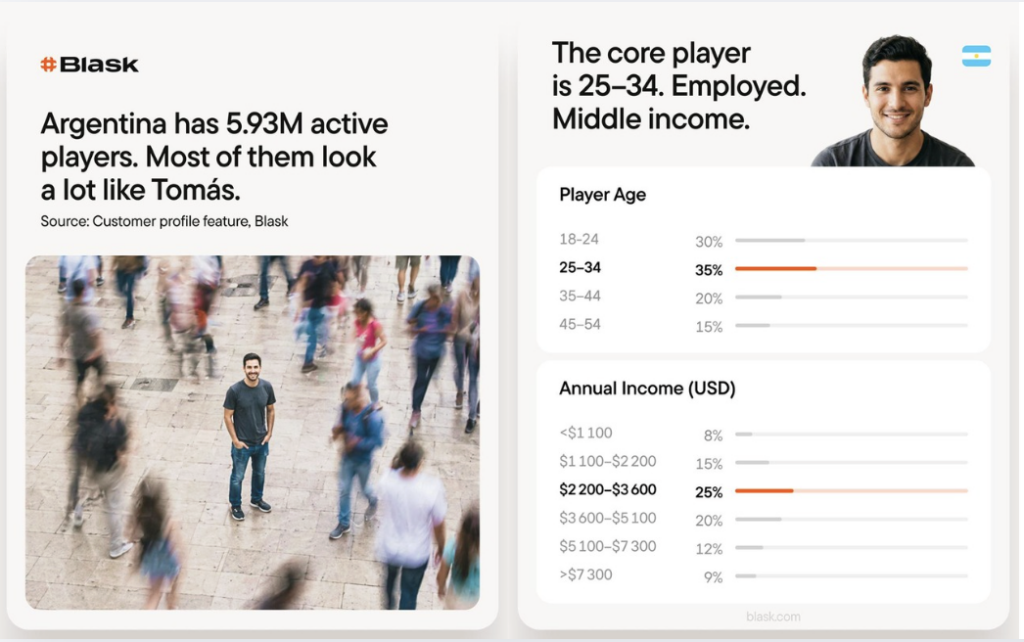
Blask Customer Profile helps operators understand the typical player in a market: demographics, income, education, device usage, betting motivations, product preferences, and risk indicators.
This matters because the same product can require different execution by country. A mobile-first market needs faster onboarding, lighter flows, and reliable payment UX. A football-led betting market needs different campaigns from a live casino market. A price-sensitive audience will react differently to bonuses, odds, withdrawal speed, and trust signals.
Customer Profile also helps explain seasonality. In some markets, sports calendars drive demand. In others, payday cycles, farming seasons, religious periods, holidays, or local events can affect when players have money and attention.
For CRM teams, this changes timing. For affiliates, it changes content. For operators, it changes product priorities.
Use games and content as a market-entry signal
Games data turns market research into product strategy.
Before entering a market, operators should ask which games dominate lobbies, which providers appear most often, and which titles generate user demand. If your platform provider does not support the games players already recognize, market entry becomes harder.
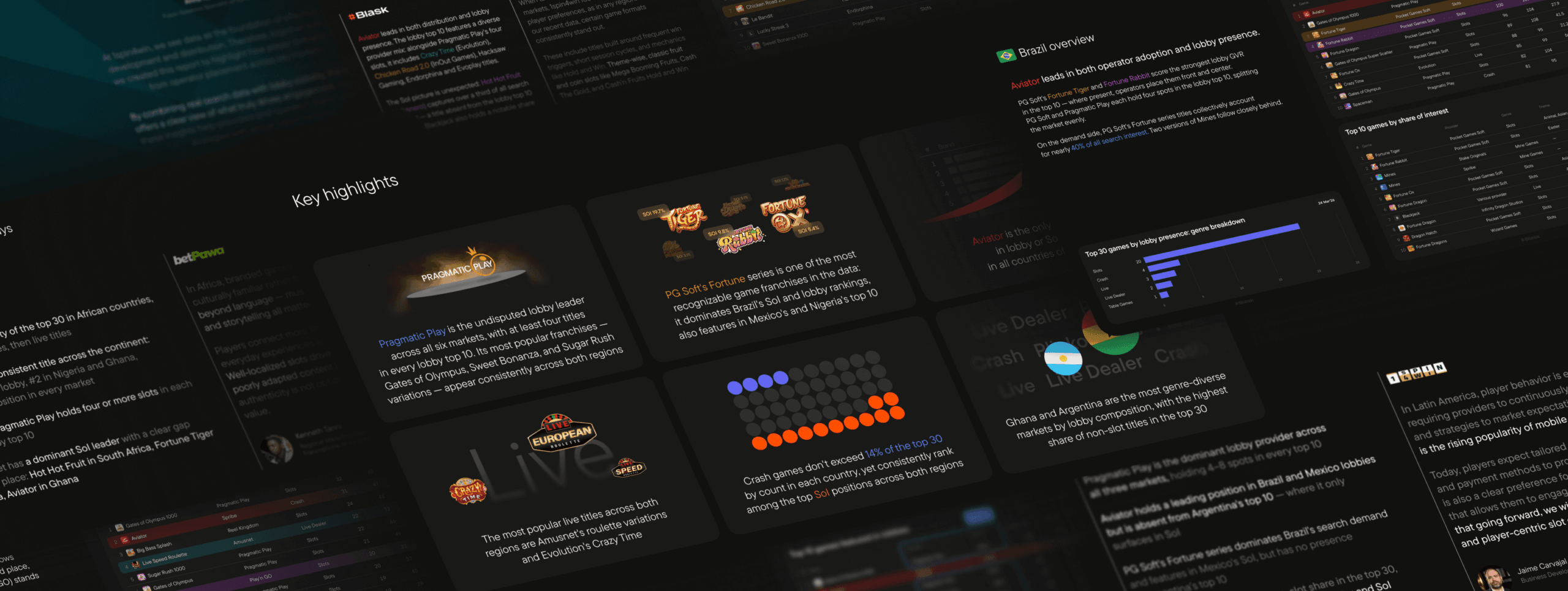
Affiliates should ask the same question from the traffic side. If Aviator, Crazy Time, Chicken Road, or a specific slots cluster dominates user interest in a country, those games can shape SEO pages, paid social creatives, reviews, and comparison content.
The strongest signal appears when lobby visibility and player interest point to the same titles. If many operators place a game high in the lobby and players also search for it, the title has both supply-side and demand-side support.
That is the difference between content guessing and content planning.
Find the brands that prove entry is possible
A market becomes more attractive when recent entrants can gain share.
This is one of the highest-value checks in Blask. Do not only study the leaders. Look for brands that launched recently, grew quickly, and reached a meaningful BAP position without years of legacy advantage.
These brands answer practical questions:
- How fast can a new entrant gain attention?
- Which acquisition channels seem to be working?
- Which product mix supports growth?
- Are rising brands sports-led, casino-led, local, international, mobile-first, or app-first?
- Do similar brands succeed across adjacent markets?
For affiliate programs, this same analysis helps identify threats. If new brands enter your existing market and start gaining demand, they are competing for your traffic, your partners, and your players.
For affiliates, it helps identify buyers. Fast-growing operators with visible acquisition momentum are more likely to need traffic now.
Compare similar markets, not just famous markets
The best next market may not be the largest one. It may be the one most similar to a market where you already win.
Similarity can come from:
- Shared player preferences
- Similar category mix
- Overlapping operators
- Comparable seasonality
- Similar payment behavior
- Similar game and provider demand
- Comparable acquisition economics
India and Bangladesh show why this matters. In Blask data for April 27, 2025 to April 26, 2026, India had 464 active brands and an average CEB of $4.68B ($2.34B–$11.7B range). Bangladesh had fewer active brands, 158, but a higher total Blask Index over the same period at 817.66M.
That does not make Bangladesh “better” than India. It means the two markets require different questions. India offers a larger revenue ceiling in Blask’s CEB model, while Bangladesh shows strong demand concentration with fewer tracked active brands. An operator already succeeding in one should study whether the other shares enough product, traffic, and seasonality patterns to justify expansion.
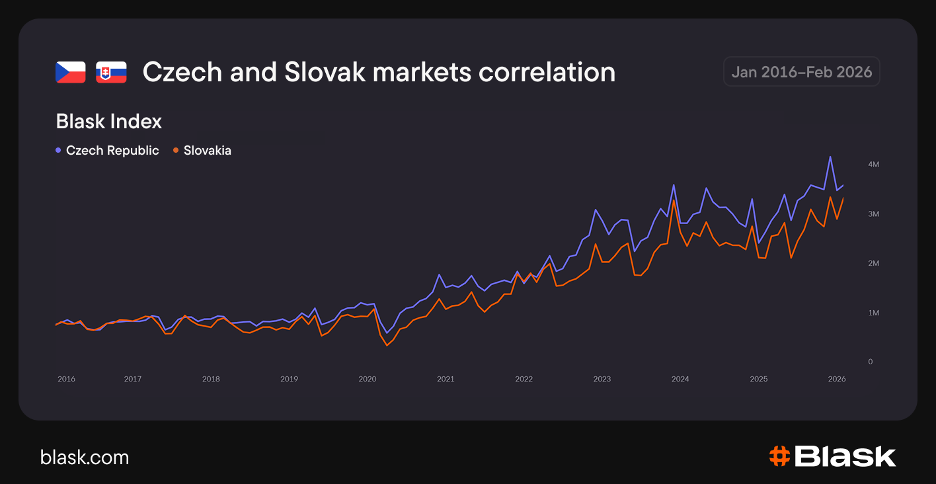
This is a more useful way to build a market shortlist than chasing the loudest country in the industry conversation.
A practical checklist for choosing an iGaming market
Use this sequence before committing budget:
- Demand trend: Is Blask Index rising, falling, or flat across several periods?
- Market concentration: Do a few brands control demand, or is share distributed?
- Revenue ceiling: What does CEB say about market value under realistic competitive conditions?
- Acquisition pressure: Which brands show rising APS, and what does that imply about paid demand?
- Category fit: Do betting, casino, live dealer, poker, games, or lottery demand match your product?
- Regulatory cost: Can you operate, advertise, pay out, and acquire players under local rules?
- Player profile: Does the audience match your product, pricing, language, and CRM model?
- Games and providers: Do the top games and providers match your platform or content strategy?
- Recent entrants: Have newer brands gained share, and how quickly?
- Market similarity: Is the market close enough to one where you already have an edge?
If the answers line up, the market deserves a deeper business case. If they do not, the market may still be interesting, but it is not ready for launch.
Blask makes market entry a repeatable process
Choosing an iGaming market should not depend on a country list, a conference trend, or a single growth chart.
The stronger approach is repeatable. Start with demand. Test concentration. Size the acquisition and revenue opportunity. Check regulation. Match categories, games, and player behavior. Then compare the market to places where your team already performs.
Blask brings those signals into one workflow, from market-level Blask Index and BAP to APS, CEB, category demand, Customer Profile, and games data.
The result is not a guess about where the industry is going. It is a clearer answer to the question that matters: where can this business win next?